 |
U.S Afghanistan Iran International |
 |
 |
|
Ukrainian star disqualified from Winter Olympics over helmet honoring war dead
The International Olympic Committee told Vladylsav Heraskevych that his "helmet of remembrance" violated its rules prohibiting political statements.
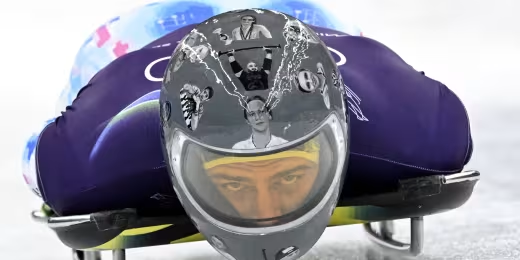
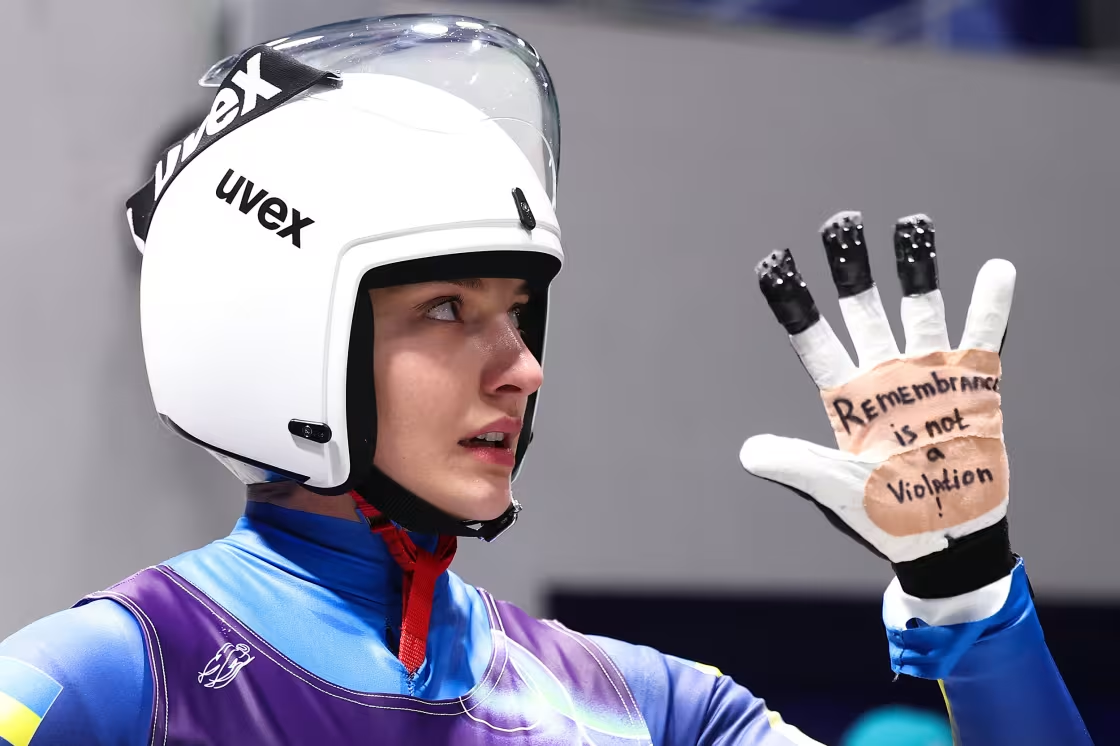
A Ukrainian athlete who was disqualified from the Winter Olympics on Thursday over his insistence on wearing a helmet honoring people killed in his country`s war with Russia said he refused to back down because there are things that are "more important than medals." The International Olympic Committee said in a statement early Thursday that skeleton racer Vladyslav Heraskevych, the Ukrainian flag bearer, was "not allowed to participate at Milano Cortina 2026 after refusing to adhere to the IOC athlete expression guidelines." Heraskevych told NBC News that the decision was "surreal." "I feel like I was treated unfairly. I was stripped out of opportunity to compete, and I don`t understand why," he said. The decision was announced shortly before Heraskevych was due to compete in the men`s skeleton competition, in which he was considered a legitimate medal contender. He told NBC News that he was already in the venue and had set up his sled for his race when he was notified he was being disqualified. "I believe I am right in this case," Heraskevych told NBC News. "For me to back down is betraying [the people pictured on the helmet]." Heraskevych, who indicated he may appeal to the Court of Arbitration for Sport, is talking to lawyers to "fight for our rights." Even still, he said it would be a "miracle" to compete in these Games. The IOC said earlier this week that his "helmet of remembrance" - featuring pictures of Ukrainian athletes killed during the war - contravened rules prohibiting any kind of political statement by competitors. Heraskevych insisted the helmet does no such thing and wore it throughout training runs. "We`re dragging all this attention from the athletes, from other Olympians, to this scandal," he said. Heraskevych also pointed to athletes in other Winter Olympic sports - including snowboarding, skiing, figure skating and luge - who have the opportunity to share messages and expressions on their gear. "They didn`t receive any penalties, any suspensions, or something like that," he said. Kyiv labeled his disqualification a "moment of shame" for the IOC. "The Olympic movement should help stop wars, not play into the hands of aggressors," President Volodymyr Zelenskyy said in a post on X. "No rule has been broken," he insisted, praising Heraskevych for his stand. "Having courage is worth more than any medal," Zelenskyy added. Heraskevych said the support from both the Ukrainian president and the international community has been "huge." The decision was taken, the IOC said, by a jury of the International Bobsleigh and Skeleton Federation. Multiple meetings and exchanges were held between Heraskevych and IOC officials. But the committee said the athlete "did not consider any form of compromise," including after a final meeting with the committee`s president, Kirsty Coventry, at the sliding center Thursday. Coventry, an Olympic champion swimmer, said she had wanted a different outcome. "No one, no one - especially me - is disagreeing with the messaging. The messaging is a powerful message," she told reporters, with tears rolling down her face as she spoke. "As you`ve all seen over the last few days, we`ve allowed for Vladyslav to use his helmet in training," Coventry said. "The challenge that we are facing is that we wanted to ask or come up with a solution for just the field of play." Heraskevych said, "She was telling me that she really wants me to compete. But at the same time, she couldn`t explain to me, what is the difference between my case and case of other others?" Rule 50.2 of the Olympic Charter states: "No kind of demonstration or political, religious or racial propaganda is permitted in any Olympic sites, venues or other areas." Heraskevych told NBC News that the IOC told him that the helmet also violates part of rule 40, which he said is regarding the media and how athletes can express themselves at the Games. The IOC insisted it was "very keen for Mr Heraskevych to compete" and offered him a compromise option of allowing him to wear the helmet during training and to display it immediately after the competition, or to wear a black armband to symbolize national mourning - but it drew a line at allowing him to wear the helmet while competing. "The essence of this case is not about the message, it is about where he wanted to express it," the IOC said.
Heraskevych displayed a "No war in Ukraine" sign after his final run at the 2022 Winter Olympics in Beijing, which the IOC said did not violate its charter as he was simply calling for peace. Russia launched its full-scale invasion days after the Games ended. Heraskevych said the images on his helmet in Milan feature figure skater Dmytro Sharpar, his 2016 Youth Olympic Games teammate, and boxer Maksym Halinichev among others killed during the war. Some of them were Olympians, others children, and even some of Heraskevych`s friends were included. "All of them were athletes or people closely related to sports," he said, adding that he wanted to "memorize them" at the Olympics, because even though they were killed, they still made it there." The "whole world can memorize them all together in a beautiful tribute. It was a goal from the first day," Heraskevych said. "I would say [it`s] painful that it really looks like discrimination because many athletes already were expressing themselves. ... They didn`t face the same things. So, suddenly, just the Ukrainian athlete in this Olympic Games will be disqualified for the helmet," Heraskevych said Thursday. He has also been vocal about the presence of athletes who formerly represented Russia and Belarus at the Olympics, questioning their status and why the IOC has cleared them to compete. Ukraine`s Olympic Committee said in a statement after the ruling Thursday: "Vladislav did not start today, but he was not alone - all of Ukraine was with him. Because when an athlete stands up for truth, honor and memory - this is already a victory." The country`s foreign minister, Andrii Sybiha, described it as "a moment of shame." "The IOC has banned not the Ukrainian athlete, but its own reputation," he said in a post on X. It is "Russians who must be banned, not the commemoration of their victims," Sybiha added. "The Olympics is about peace. And I don`t see anything what can disturb people in this pictures," Heraskevych said. The "helmet was called by people `memory helmet.` It`s not a conflict helmet." He added: "Some things are more important, and I believe honoring and remembering these athletes is now more important than medals." Patrick Smith, Yuliya Talmazan reported from London, Molly Hunter reported from Cortina d`Ampezzo and Rebecca Cohen reported from New York.
|
 |
|
|
|
U.S
Afghanistan
Iran
International
Social
Economic
Articles |
Athletic
Read
Science
Medical
Interview
Art and Culture
Travel |
|