 |
U.S Afghanistan Iran International |
 |
 |
|
Energy secretary says he is working with Venezuelans and oil companies to create conditions for expanded oil production
"If we can’t successfully make those changes in Venezuela, the capital won’t flow," Chris Wright, Trump`s top liaison to the oil industry, said.
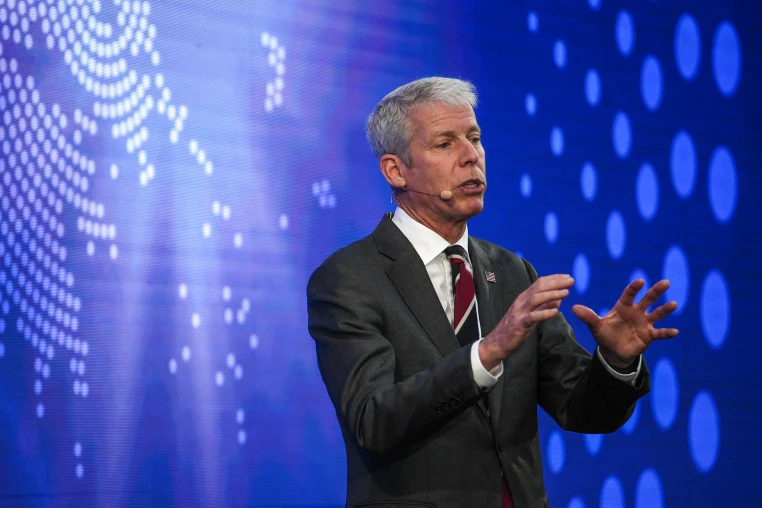
Energy Secretary Chris Wright said Wednesday that he is "working directly in cooperation with the Venezuelans" and U.S. oil companies to explore the conditions under which oil production could be expanded. "We`re going to have that [oil] flowing again," Wright said at the Goldman Sachs Energy, CleanTech and Utilities Conference in Florida. "As we make progress with the [Venezuelan] government, you know, we`ll enable the importing of parts and equipment and services to kind of prevent the industry from collapsing, stabilize the production, and then as quickly as possible, start to see it growing again," he added. The Venezuelan oil industry and economy are currently under strict U.S. sanctions, which were recently expanded to include a full blockade of oil exports. Wright`s comment appeared to suggest that these sanctions might be eased, but he did not address the question directly. "This should be a wealthy, prosperous, peaceful energy powerhouse," Wright said. "In the long run," Wright said, the Trump administration hopes to "create the conditions that the major American companies that were there before, maybe that weren`t there before but want to be there, will go in." U.S. oil giants Exxon Mobil and ConocoPhillips fully exited Venezuela in 2007, after the government nationalized energy infrastructure there. Chevron is the only U.S. firm currently operating in Venezuela, under a narrow license issued by the Trump administration. Since the U.S. captured President Nicolás Maduro and President Donald Trump began sharing his hopes for the future of Venezuela`s oil, Exxon Mobil, Chevron and ConocoPhillips have all been quiet about the prospect of expanding or re-entering Venezuela`s oil industry. In the short to medium term, Wright said he sees expanded Venezuelan oil production by "several hundred thousand barrels a day" as a possibility. He did not specify precisely what that timeline might look like, or what entity would execute that expansion. Moderator Neil Mehta, Goldman Sachs` head of natural resources research, also asked Wright about the importance of companies getting a return on any investments they might make in Venezuela. Wright said market forces would determine whether Venezuela was a good investment or not. "We`re either going to make that happen, make those changes in Venezuela and the capital will flow, or if we can`t successfully make those changes in Venezuela, the capital won`t flow," he said. "One of the first things I`ve been doing is talking to all the players that were in Venezuela, that are in Venezuela, that want to go into Venezuela," he said. In those talks, Wright said he is asking the companies, "What are the necessary conditions it would take you to put billions of dollars in to develop [oil] fields and build infrastructure?" Wright did not say whether any oil companies had committed to re-enter the country or, in Chevron`s case, to expand production. Executives from Exxon, Chevron and Conoco will visit the White House on Friday for a meeting with Trump, an administration official told NBC News on Wednesday. Wright will also join that meeting. On Tuesday evening, Trump said on Truth Social, "the Interim Authorities in Venezuela will be turning over between 30 and 50 MILLION Barrels of High Quality, Sanctioned Oil, to the United States of America." "I have asked Energy Secretary Chris Wright to execute this plan, immediately," Trump posted. Wright said the 30 million to 50 million barrels of oil refers to "crude that`s backed up in onshore storage and that`s in offshore floating storage." Due to what Trump called a "blockade" on Venezuela`s oil industry in the weeks preceding Maduro`s capture, Venezuela`s onshore oil tanks have neared capacity. Venezuela also has around 22 million barrels of oil sitting in ships offshore, according to data from Kpler that was reported by Bloomberg News. "We`re going to market the crude coming out of Venezuela," Wright said at the Goldman Sachs conference. Once the backlog is cleared, he said, the U.S. will "indefinitely ... sell the production that comes out of Venezuela into the marketplace." Wright said the U.S. will supply the diluent that is required to render Venezuela`s heavy, sour crude oil easier to move. He also said that oil sales would be "done by the U.S. government and deposited into accounts controlled by the U.S. government and then from there those funds can flow back into Venezuela to benefit the Venezuelan people." On Wednesday morning, the price of WTI, or U.S. crude oil, had fallen around 1%.
|
 |
|
|
U.S
Afghanistan
Iran
International
Social
Economic
Articles |
Athletic
Read
Science
Medical
Interview
Art and Culture
Travel |
|